
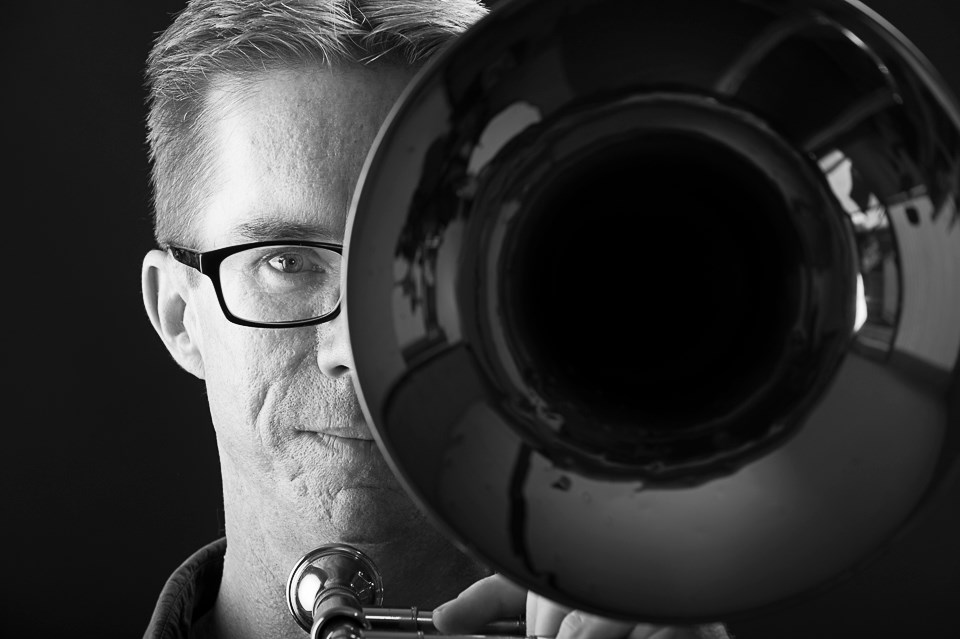
This is a guest post written by Aeyons trombone teacher Mark Hampson.
Check out my first article in a series talking about the various aspects of trombone playing. This first one is a piece about sound concept and how to approach the relationship between air and vibration.
These unprecedented times we are all living in right now have had their ups and downs for all of us. For me, it has been a time of many changes in my life, but it has also provided me with the perfect opportunity to think again about my lifestyle and, in particular, my relationship to my instrument. Have you found, like me, that the COVID-19 crisis has given you a new opportunity to think about what you would like to achieve?
I find many far-reaching implications for my technique and approach as I consider this, both specifically to the trombone and in more general musical terms. Many of which I would like to take the time to talk about and contemplate in this blog.
For this first article, the idea of sound and what it means for my connection to the instrument came to mind.
This is something I have been mulling over for the best part of a year now, the seed of which was sown when I started to think about what it is that the trombone really does to convert my vibrating lips into the most beautiful sound I can imagine. An integral part of this is the search for the most efficient way of turning the air into the sound I am looking for. What do you notice when you listen to your heroes playing? Do you also get that familiar feeling that they are barely doing anything to get results that would take a lot of energy for most people to produce?
I am lucky enough to be able to give courses and masterclasses the world over, and I have used these occasions to propose a particular question to trombonists globally. This being, “what do they think the trombone does to our buzzing lips in order produce our ideal, pristine sound?”.
The most common answer to this is, “it amplifies the buzz”, but this is only half the story as far as I am concerned.
Which of the following questions makes more sense to you? “What does the trombone do to my buzzing lips to realise my ideal sound?”, or do you prefer, “what do my buzzing lips do to the trombone to create the sound I have always wanted?”? I find the second one to be more effective as I think about my ideal sound. One of the first things which caused me to think about this was hearing my old professor from the Guildhall in London, John Kenny, talking about how buzzing lips “activate” the trombone.
For some reason this idea really “resonated” with me, and therein lies the crux of the matter. Essentially our buzzing lips act upon the air inside the majority of our trombone tubing causing it to vibrate and create the sound we want when we allow it to. Effectively we need to harness the resonating quality of most of our instrument, but especially the lead pipe and slide. The amplifying only really starts just before the main tuning slide where the tubing starts to broaden.
It follows that what arrives at this junction in the instrument between resonator and amplifier needs to be of the maximum quality. I often think of it as a high-end hifi system, it makes no sense to invest thousands in an audiophile amplifier if your source is a low-end mp3 player. The amplifier will just faithfully reproduce all the shortcomings of your inferior source. The same goes for our instrument, if the quality of our air and buzz isn’t as good as it should be, the bell section will do an excellent job of highlighting this.
One day during quarantine I suddenly came across that sweet spot where the instrument seems to be sounding all by itself. Do you find the following couple of images helpful as your instrument begins sounding for you?
In the first, I like to think of buzzing like the sound I produce circling my wet finger around the rim of a wine glass. It should be slow and constant, never stopping and always with the same pressure, that way the wine glass always sings for me.
In the second I think of the sound I am able to make by blowing across the top of an open wine bottle (I seemed to have a few empty bottles around in my quarantine life!). I love this idea because it helps me to envisage the air I need for the bass trombone, the bottle will only cooperate with a slow warm air and stops working efficiently if our air is too fast or aggressive. I find my instrument behaves in a very similar way, you could think about coaxing the instrument rather than pushing the sound out.
How can you remind yourself to think about these images as you raise your trombone to play the first notes of the day?
I enjoy remembering that my embouchure is nothing more than an energy converter, it converts one sort of energy, the forward motion of our air, into sound energy when our lips vibrate. Once the air has passed through our “converter”, its job is done. It passes through the instrument because there is nowhere else for it to go. A good analogy for this is an internal combustion engine which converts chemical energy in fuel into forward motion. The resulting gases leave the engine through the exhaust because there is nowhere else for them to go.
One day I was playing through slow, piano arpeggios, and I suddenly felt the instrument wake up. Producing sound suddenly felt so easy, much like when a tennis ball connects with the sweet spot on a racket, it’s a great feeling and it helps to say to yourself, “How will I know when I have found the sweet spot on my trombone?”.
Posing myself these questions helps me to realise my objective, uniting my buzzing lips elegantly with my flowing air. As I do this, I activate my trombone. Your instrument will reward you by resonating as it was designed to do if you create the right conditions, through resonance you will find your way to resounding success!

